Table of Contents
▼
What are the 7 mistakes first-time Indian founders make with a US LLC?
The seven mistakes are: defaulting to Delaware, ignoring FEMA/ODI rules, applying for the wrong tax ID, skipping the operating agreement, picking a bank that freezes non-resident accounts, missing annual filings and the Form 5472 trap, and treating the LLC as a one-time setup instead of an ongoing compliance system.
Quick Answer: If you are an Indian resident forming a US LLC, the two biggest traps are not legal in the US at all — they are Indian. FEMA treats your US LLC as a foreign entity, and a foreign-owned single-member LLC still has to file Form 5472 with a pro forma Form 1120 every year or face a penalty that starts at $25,000. Get the state, the EIN, the operating agreement and the annual calendar right, and the rest is paperwork.
Each mistake below follows the same shape: what goes wrong, the India-specific rule most guides skip, and the fix. You will also see the cost of getting it wrong — wasted state fees, IRS penalties, frozen revenue, and FEMA contravention that is expensive to unwind.
If you are searching how to register an LLC in USA from India, the flow is not complicated. The mistakes are in the details.
Mistake 1: Choosing Delaware just because everyone else does
Delaware is the right state for a VC-backed C-Corp. It is usually the wrong state for a bootstrapped single-member LLC run from India. Wyoming or New Mexico is cheaper and simpler for most people.
Here is why the Delaware default bites. Delaware charges $110 to file a Certificate of Formation and then a $300 annual franchise tax, plus a registered agent. Wyoming charges around $100 to file and a $60 annual report. New Mexico has no annual report at all. If you are running a solo software business from Bengaluru, that difference is real money for zero benefit.
Nexus matters here. If you have no US office, no US employees and no US inventory, you generally do not need to register in a second state. You form in one state and that is it. The trap is people who form in Delaware and then also register in Wyoming "just in case" — that doubles your annual filings for nothing.
The fix: pick the state based on your business model, not on Twitter advice. Selling through Stripe? Wyoming or New Mexico. Raising US venture capital? Delaware. Operating a physical US presence? Then register where the presence is.
| State | Formation fee (government) | Annual fee (government) | Registered agent (provider, recurring) | Best for |
|---|---|---|---|---|
| Delaware | $110 | $300 franchise tax | ~$50–$150/yr | VC-backed C-Corps |
| Wyoming | ~$100 | $60 annual report | ~$25–$100/yr | Bootstrapped single-member LLCs |
| New Mexico | ~$50 | None | ~$35–$100/yr | Low-maintenance LLCs |
| Your operating state | Varies | Varies | Varies | US physical presence |
Note: government fees above are separate from registered agent and provider fees. Never blend them into one number when you budget.
Mistake 2: Ignoring FEMA and ODI rules because 'it's just a US company'
Under FEMA, a US LLC is a foreign entity. An Indian resident generally cannot hold foreign equity without an ODI route, and most founders discover this only when they try to repatriate money. This is the section most guides get wrong — either they ignore it or they hand-wave "consult a CA."
Here is the honest version. There are two clean routes for an Indian founder:
- Route A — ODI. An Indian company makes an Overseas Direct Investment into the US LLC under the ODI Master Direction. This is the textbook route and it is what your CA will recommend if you already have an Indian entity.
- Route B — Change of residential status. You move to the US (or otherwise change your residential status) before forming. Once you are no longer an Indian resident for FEMA purposes, the constraint lifts.
What goes wrong if you skip this: FEMA contravention, compounding penalties, and banks refusing inward or outward remittances. Your US revenue sits in a US account you cannot cleanly bring home.
The fix: talk to a CA who handles FEMA/ODI before you file Articles of Organization, not after. Document your source of funds. Do not file first and ask later — unwinding is far more expensive than getting it right.
Heads-up: this is the section that needs CA/legal verification. Do not treat this article as legal advice. Treat it as the list of questions to bring to your CA.
Mistake 3: Applying for the wrong tax ID (EIN vs ITIN vs SSN)
Your LLC needs an EIN (Employer Identification Number), which you get by filing Form SS-4. An ITIN (Individual Taxpayer Identification Number) is only for individuals who must file a US personal return and have no SSN. Most Indian founders do not need an ITIN to form an LLC or open a fintech account.
This is where people burn weeks. There are two EIN application routes:
- Form SS-4 by fax or mail. This is the route for non-US residents without an SSN. You write "Foreign" or "N/A" on the SSN line.
- Online EIN. Only available if you have an SSN or ITIN. If you do not, the online tool will reject you.
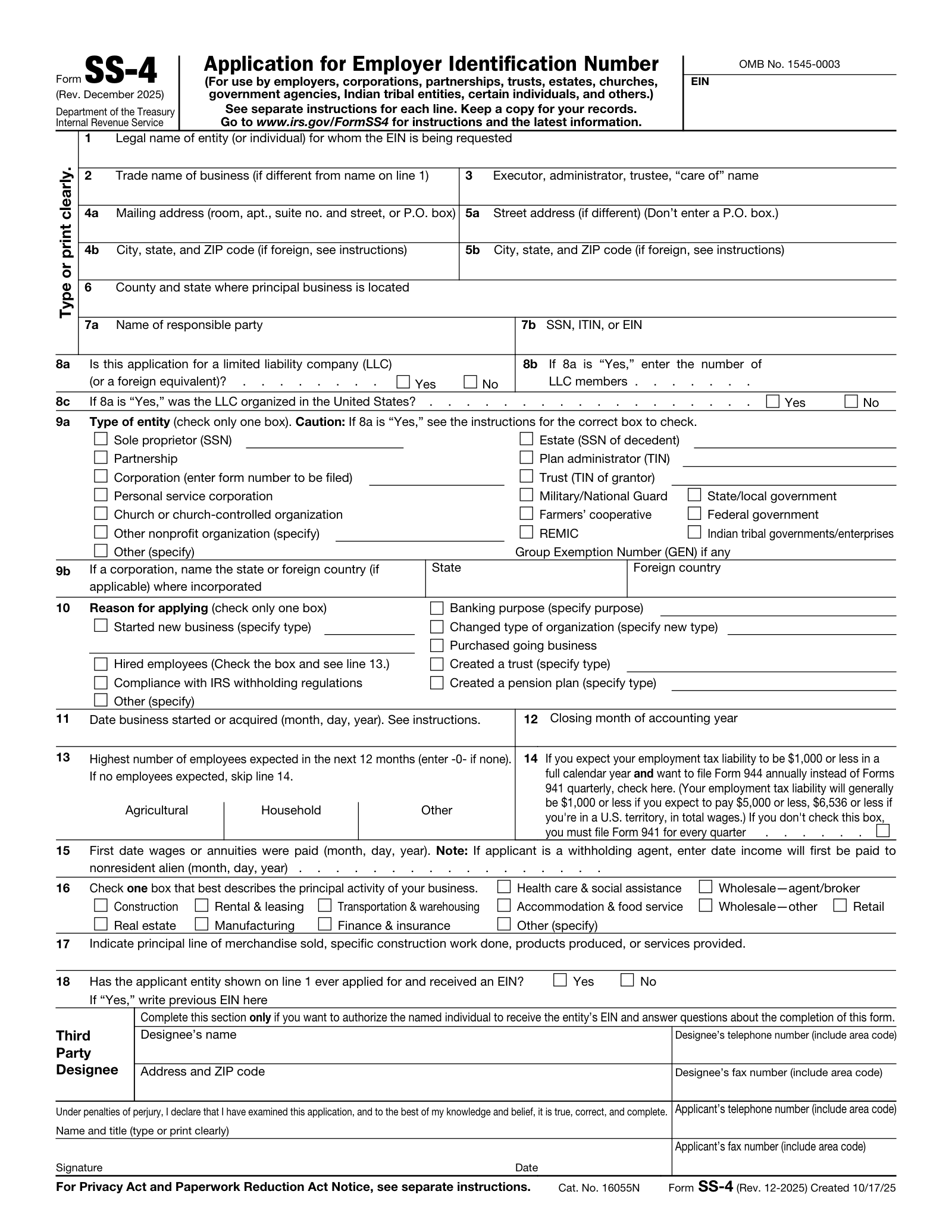
Official form (IRS.gov): Form SS-4 official PDF
The other ID trap: W-8BEN (for individuals) or W-8BEN-E (for entities) is the correct form for a US client or bank. W-9 is for US persons. If a US client sends you a W-9, they have the wrong form — send back a W-8BEN-E.
The fix: apply for the EIN correctly the first time. A wrong responsible-party entry causes rejection and weeks of delay. Match the legal name on the SS-4 exactly to the name on your Articles of Organization.
Mistake 4: Skipping the operating agreement because 'it's a single-member LLC'
Banks, payment processors and some states ask for the operating agreement. Without one, your LLC looks like an alter ego and you weaken the liability shield that was the whole point of forming it.
For a single-member LLC, the operating agreement does not need to be long. It needs to cover: ownership, capital contribution, management, dissolution, and the India-specific tax classification. That last item matters because by default a single-member LLC is a disregarded entity — the IRS ignores it for tax purposes and taxes the owner directly. If you want corporate treatment instead, you file Form 8832 to elect it.
Official form (IRS.gov): Form 8832 official PDF
The fix: sign a simple operating agreement at formation. It costs nothing but a template and a signature. Keep it updated when ownership changes. If a bank asks and you do not have one, you look unformed.
Mistake 5: Choosing a bank that freezes non-resident accounts
Many US banks reject or freeze accounts owned by Indian residents with no SSN and no US address. Fintechs built for non-residents — Mercury, Wise Business, Payoneer — are the practical first account for most founders.
Why freezes happen: KYC/AML checks, no SSN, no US physical address, mismatched business activity, and sudden large transfers. A freeze is not a rejection — it is a hold while the bank asks for documents. If your business description on the application does not match what your transactions look like, the freeze becomes a closure.
| Option | What they need | Monthly fee | Indian-resident owner? |
|---|---|---|---|
| Traditional US bank | In-person visit, SSN, US address | Varies | Usually no |
| Fintech business account (Mercury, Brex-type) | EIN, Articles, operating agreement, passport | Varies by plan | Check current policy |
| Wise Business / Payoneer | EIN, business details, ID | Varies | Check current policy |
Note: bank and fintech acceptance policies change frequently. Mercury publishes its own eligibility rules and updates them — as of early 2026, verify current requirements before you apply. Approval is always the provider's decision, not something an LLC guarantees.
The fix: apply with a consistent business description, a real registered agent address, and your documents ready — EIN letter, Articles, operating agreement. Do not apply to three banks at once with three different business descriptions.
Mistake 6: Missing annual filings and the Form 5472 trap
A foreign-owned single-member LLC must file Form 5472 with a pro forma Form 1120 every year, even with no income. The penalty for not filing starts at $25,000.
This is the single most expensive mistake on the list, and it is the one most guides bury. The filing is due by April 15 (or the extended deadline if you file for an extension). It is separate from any personal return you might file.
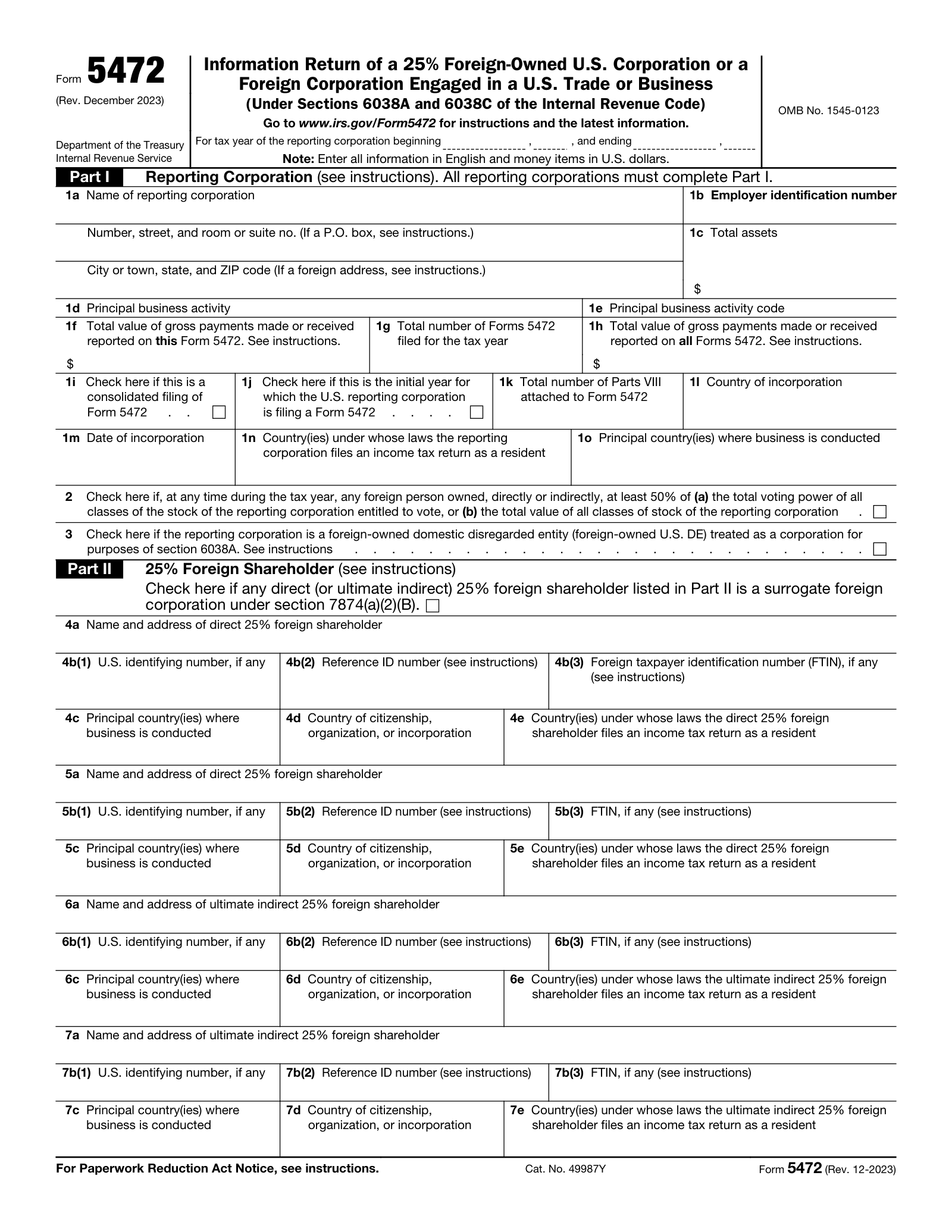
Official form (IRS.gov): Form 5472 official PDF
On the state side, deadlines differ:
- Wyoming: annual report due by the first day of the anniversary month.
- Delaware: franchise tax due by March 1.
- New Mexico: no annual report.
The fix: put both deadlines in your calendar at formation. Use a CPA familiar with foreign-owned disregarded entities. Do not assume your Indian CA knows Form 5472 — most do not.
Mistake 7: Treating the LLC as a one-time setup instead of an ongoing compliance system
The LLC is a recurring obligation: registered agent renewal, state annual report, federal Form 5472, bookkeeping, and FEMA/ODI reporting on the India side. Budget for it before you form.
A simple annual calendar looks like this:
- Month of formation anniversary: state annual report (Wyoming).
- March 1: Delaware franchise tax (if Delaware).
- April 15: Form 5472 + pro forma 1120.
- Ongoing: registered agent renewal, bookkeeping, FEMA/ODI compliance.
- Government fees: state formation fee, state annual report/franchise tax.
- Provider fees: registered agent, formation service.
- Recurring: registered agent renewal, CPA for Form 5472, bookkeeping.
Cost layers, kept separate:
The fix: assign one person to own the calendar — you or your CA. If nobody owns it, it slips.
Common mistakes vs the fix: a quick reference table
| Mistake | What goes wrong | India-specific rule | The fix | Who to ask |
|---|---|---|---|---|
| Delaware default | Wasted fees, extra filings | None (US-side) | Pick state by business model | Yourself |
| Ignoring FEMA/ODI | Contravention, blocked remittances | FEMA treats US LLC as foreign | CA before filing | CA |
| Wrong tax ID | Rejected EIN, weeks lost | ITIN not needed for most | Form SS-4, no SSN line | Yourself / CPA |
| No operating agreement | Weak liability shield, bank rejection | Tax classification matters | Sign at formation | Yourself |
| Bad bank choice | Frozen revenue | No SSN, no US address | Fintech first, docs ready | Provider |
| Missing Form 5472 | $25,000 penalty | Federal, applies to foreign-owned | Calendar + CPA | CPA |
| One-time mindset | Missed deadlines, penalties | ODI reporting ongoing | Assign an owner | CA / CPA |
Frequently Asked Questions
Can an Indian resident legally own a US LLC?
US law allows it. The constraint is Indian FEMA/ODI rules on holding foreign equity as a resident. The usual routes are an Indian company's ODI investment or a change of residential status. Verify with a CA.
Do I need an SSN or ITIN to form a US LLC from India?
No. You need an EIN via Form SS-4. An ITIN (Form W-7) is only needed if you must file a US personal return and have no SSN.
Which state is best for an Indian founder's US LLC in 2026?
Wyoming or New Mexico for most bootstrapped single-member LLCs. Delaware only if you plan to raise US VC or convert to a C-Corp.
What happens if I don't file Form 5472?
The IRS penalty starts at $25,000 per year for a foreign-owned single-member LLC that fails to file Form 5472 with a pro forma Form 1120.
Can I open a US bank account as an Indian resident?
Traditional banks often refuse or freeze. Fintechs like Mercury, Wise Business and Payoneer are the practical route — requirements change, so verify current KYC rules.
Do I have to pay US tax on my US LLC income if I live in India?
A disregarded single-member LLC is generally not taxed at the entity level. The owner's tax position depends on residency, US-source and effectively connected income, treaty rules, and entity classification. Get cross-border tax advice.
Common Mistakes
- Name mismatch. The legal name on your Articles, EIN letter, and bank application must match exactly. A missing "LLC" or a middle initial causes rejections.
- Using a personal address as the registered agent address. Some providers accept it; most banks do not. Use a real commercial registered agent address.
- Filing the EIN before the LLC is approved. The SS-4 asks for the date of formation. If the state has not approved you yet, the EIN application can be rejected.
- Assuming your Indian CA knows Form 5472. Most do not. Find a US CPA who handles foreign-owned disregarded entities.
- Treating FEMA as a US problem. It is an Indian problem. Your US lawyer will not flag it.
- Skipping the operating agreement because "nobody asked." The bank will ask. So will a future investor.
If you want help with US LLC formation, EIN and business setup, NexFyla can assist — including the state choice, registered agent, EIN application, and banking support for non-US founders.
*Last updated: February 2026.*
Sources
[1] US LLC From India: 7 Mistakes First-Time Founders Should Avoid — https://www.linkedin.com/pulse/us-llc-from-india-7-mistakes-first-time-founders-should-avoid-cwnif
[6] 5 LLC Mistakes That Cost First-Time Founders Real Money — https://bizupusa.com/blog/5-llc-mistakes-that-cost-first-time-founders-real-money
[7] Anyone established an LLC in the US from India? — https://www.reddit.com/r/indianstartups/comments/1nio98r/anyone_established_an_llc_in_the_us_from_india_is/
[8] How to open an LLC in the USA for nonresidents — https://stripe.com/resources/more/how-to-open-an-llc-in-the-usa-for-nonresidents
[9] How to start a company in USA from India? — https://wise.com/in/blog/start-company-in-usa-from-india
[12] Register LLC in USA from India (2026 Guide) — https://profitjets.com/blog/register-llc-usa-from-india/