Table of Contents
▼
Can a non-resident actually open a US business bank account?
Yes — but through a US entity, not as an individual. A non-resident opens a US business bank account by forming a US LLC or corporation, getting an EIN, and applying to a provider that accepts foreign-owned entities. Almost nobody walks into a Chase branch with an Indian passport and a dream and walks out with an account.
Quick Answer: A non-US resident can open a US business bank account, but you need a US LLC (or corporation) and an EIN first. Online providers like Mercury, Relay, Wise Business and Payoneer onboard foreign owners remotely. Traditional banks such as Chase, Bank of America and Wells Fargo usually require an in-person visit and often an SSN or ITIN. Requirements change, so confirm with the bank before applying.
There are two paths, and they are not equally open to you.
Path A — online fintech/neobank. These platforms built remote onboarding for global founders. You upload your passport, your LLC documents, your EIN letter, and a proof of address, and you wait for compliance review. No US trip.
Path B — traditional bank. Branch-based onboarding, strict Customer Identification Program (CIP) rules, and a teller who wants to see you in person. Some branches will open an account for a foreign-owned LLC if you show up with the right paperwork and sometimes an ITIN. Many will not.
The order matters: form the LLC (Wyoming, Delaware and New Mexico are the common picks), get the EIN from the IRS using Form SS-4, then apply for the account. Skipping the EIN is the single most common reason applications stall.
Note: a personal US bank account as a non-resident is a separate and harder question. This article is about business accounts.
Heads-up: acceptance criteria at every provider change, sometimes monthly. Treat the list below as a starting point, not a guarantee.
What should non-residents actually compare before choosing an account?
Compare six things: eligibility, total cost, operational fit, KYC friction, freeze risk, and exit options. An account you cannot open has a monthly fee of zero relevance. That is the filter most "best bank" lists skip.
Eligibility first
Does the provider accept your country of residence, your entity type, and your business category? If any of those three fails, stop reading that provider's pricing page. Country eligibility is the gate, not the fee.
Total cost of ownership
Separate three buckets and never blend them:
- Government fees — the state LLC filing fee, which varies by state. The IRS charges nothing for an EIN.
- One-time provider fees — formation services, registered agent setup, "banking help" packages. All optional.
- Recurring fees — monthly account fee, minimum balance, domestic and international wire fees, FX markup.
Operational fit
Do you need USD receiving only, or international wires out? Multi-currency? A debit card? ACH pull for subscriptions? Write your three must-haves before you compare anything.
Stability signals
Ask whether the provider is a licensed bank or a fintech holding your deposits at a partner bank. That structure affects what happens if the fintech changes partners or exits a market. Verify the current arrangement before you commit.
Tip: if two providers look equal on price, pick the one with the longer operating history and the clearer deposit-insurance disclosure.
Traditional banks vs fintech platforms: which one fits a non-resident?
Fintechs are usually the only realistic remote option. Traditional banks are harder to open but more stable once established. That is the whole trade in one line.
Why: traditional banks run strict CIP/KYC checks and branch-based onboarding built for US residents. Fintechs designed remote onboarding for founders who will never set foot in the US. Bank of America's own international banking pages are aimed at students and professionals arriving in the country, not at remote LLC owners [2][7].
| Factor | Traditional bank (Chase, BofA, Wells Fargo, U.S. Bank) | Fintech (Mercury, Relay, Wise Business, Payoneer) |
|---|---|---|
| Onboarding | Branch, in person | Online, remote |
| US presence required | Usually yes | No |
| SSN/ITIN | Often required | Frequently not required |
| Monthly fee | Varies — check current fee schedule | Varies — check the provider's pricing page |
| Wire fees | Varies by account tier | Varies |
| Freeze risk | Lower once established | Higher — compliance-driven |
U.S. Bank advertises business checking with bonus offers and a stated minimum opening deposit [4][9][15] — but that marketing is written for US-based businesses, and nothing on the page promises acceptance of a foreign-owned LLC. Do not read a public fee page as an eligibility policy.
[INTERNAL LINK: US LLC formation]
Many founders eventually run both: a fintech for speed and daily operations, a traditional account for stability once the business has a track record.
Fee and minimum balance comparison: what does each option really cost?
Expect $0–$25 per month in account fees at fintechs, and higher at traditional banks. The bigger numbers are wires — roughly $0–$45 each — and minimum balances, which range from $0 to $25,000 depending on tier. Those ranges are wide because provider pricing changes; check the current fee page before you apply.
| Provider | Type | Monthly fee | Minimum balance | Domestic wire | International wire | Notes |
|---|---|---|---|---|---|---|
| Mercury | Fintech | Check the provider's pricing page | Check current terms | Check current terms | Check current terms | Popular with startups; country list changes |
| Relay | Fintech | Check the provider's pricing page | Check current terms | Check current terms | Check current terms | Built for small business banking |
| Wise Business | Fintech | Check the provider's pricing page | Check current terms | Check current terms | Check current terms | Strong on multi-currency and FX |
| Payoneer | Fintech | Check the provider's pricing page | Check current terms | Check current terms | Check current terms | Marketplace payout focus |
| Brex | Fintech | Check the provider's pricing page | Check current terms | Check current terms | Check current terms | Historically startup-focused |
| Chase / BofA / Wells Fargo / U.S. Bank | Traditional | Varies by account | Varies by account | Varies by account | Varies by account | Usually in-person; SSN/ITIN often needed |
I am deliberately not putting invented numbers in that table. Fee tables that look precise and are six months stale are worse than no table.
One-time costs (government)
The state LLC filing fee. Wyoming, Delaware and New Mexico all charge one, and the amounts differ — check the current fee on the state's own website. The EIN costs $0 from the IRS.
One-time costs (provider)
Registered agent service, formation service, and "banking assistance" bundles. None of these are required to open a bank account. A registered agent is required by most states, but you can hire one cheaply without buying a banking package.
Recurring costs
Monthly account fee, minimum balance penalty, wire fees, ACH fees, FX markup. The FX markup is the quiet one — a 1% spread on $50,000 of conversions is $500 a year, and it never appears as a line item.
[INTERNAL LINK: EIN for non-US residents]
Country eligibility and KYC: who gets approved, and who gets rejected?
Most fintechs accept a wide range of countries but exclude sanctioned jurisdictions and some high-risk regions. India is broadly accepted but tends to trigger extra documentation. The bank cares far more about your country of residence than about whether your LLC is in Wyoming or Delaware.
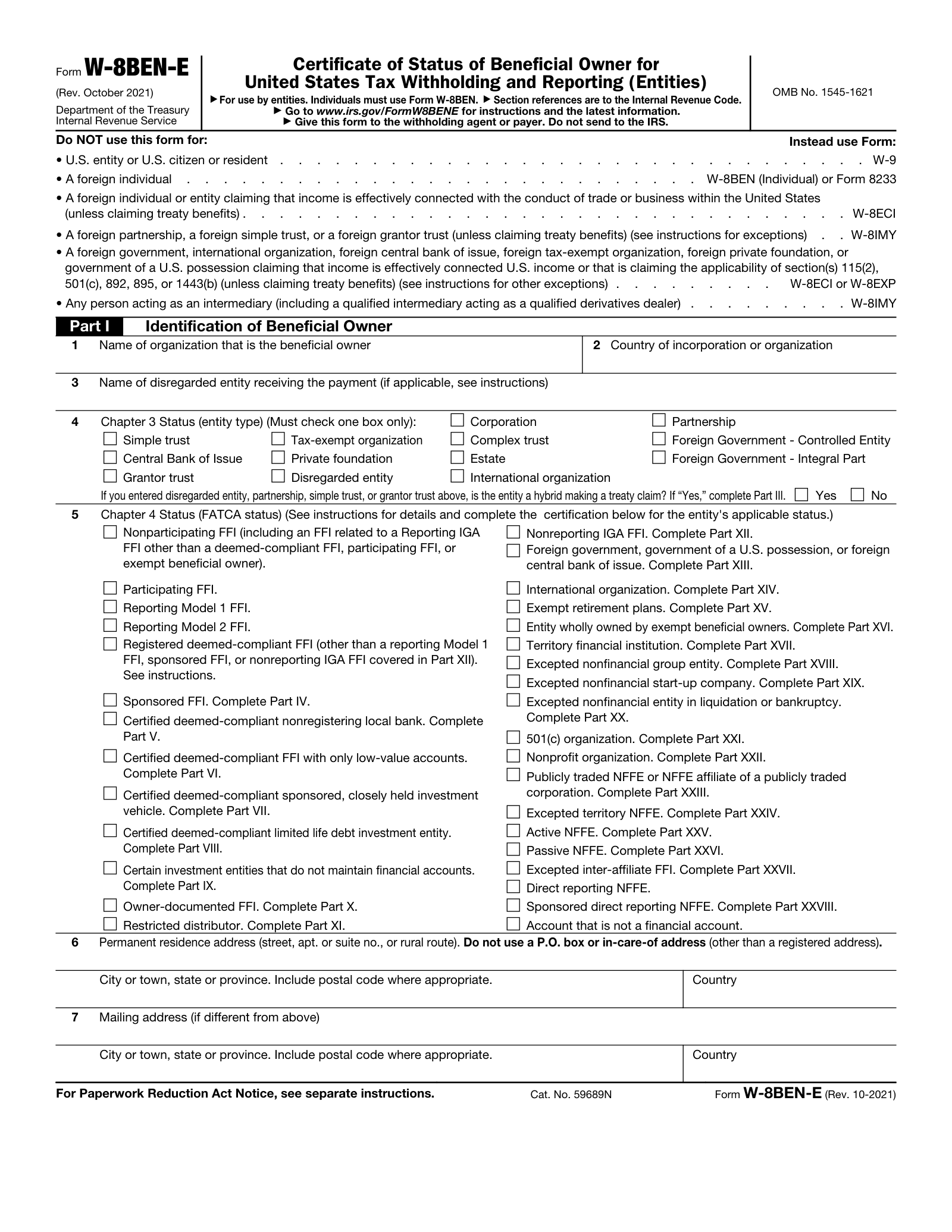
Official form (IRS.gov): Form W-8BEN-E official PDF
What KYC actually asks for
Passport, proof of residential address, LLC formation documents (Articles of Organization), the EIN letter (CP 575 or 147c), an operating agreement, and sometimes a selfie or short video. That is the standard set. Anything missing stalls the review.
Why address verification fails
This is where most applications die. A registered-agent address is not your address. A virtual office is not your address. If your LLC's registered address, your bank application address and your passport address tell three different stories, compliance flags it. Use a real, documentable address for the owner, and keep the registered agent address clearly labelled as the registered agent address.
Note: OFAC sanctions lists and provider country lists change. Check current OFAC guidance and the provider's own country list before applying.
The IRS forms banks may ask about
Foreign owners typically complete W-8BEN (individuals) or W-8BEN-E (entities) to certify foreign status. If you have a US TIN, you may be asked for a W-9 instead. At tax time, a foreign-owned single-member LLC files Form 5472 with a pro forma Form 1120 — a filing obligation that exists whether or not the LLC earned anything. Confirm your own filing position with a qualified tax professional.
Account stability and freeze risk: why non-resident accounts get frozen
Accounts get frozen for compliance reasons — sudden high-volume transfers, mismatched addresses, crypto or gambling flows, third-party deposits, incomplete KYC — not because you are a non-resident. That distinction matters, because it means most freezes are preventable.
The common freeze triggers
- Velocity spikes. An account dormant for three months that suddenly receives $80,000 from six unrelated senders looks like money laundering to an automated system.
- Pass-through behaviour. Receiving from unrelated third parties and immediately forwarding the balance out is the classic pattern compliance teams are trained to catch.
- Mismatched addresses. See above. If the application address and the documents disagree, expect a review.
- Prohibited or high-risk activity. Crypto, gambling, adult and forex flows get accounts closed at most fintechs.
- Incomplete or stale KYC. An expired passport on file is a problem the moment a review is triggered.
What happens when it freezes
Funds may be held for weeks or months while compliance reviews. You may be asked for documents you already sent. In practice, the money is usually returned eventually, but the business stops in the meantime — which is the real damage.
How to reduce risk
Keep documents current. Match every address exactly. Do not mix personal and business transactions. Do not let anyone else route money through your account. And keep a backup account, even if it sits mostly idle.
Your escalation routes
Provider support first, then the partner bank behind the fintech, then a CFPB complaint, then your state banking regulator. Verify the current CFPB complaint process before relying on it.
Which account fits your business type?
Match the account to how money actually moves through your business. The right answer for an Amazon seller is not the right answer for a SaaS founder.
E-commerce and marketplace sellers
You need reliable marketplace payouts and cheap currency conversion. Payoneer and Mercury are the usual starting points. Watch the FX spread — it eats more margin than the monthly fee.
SaaS and service businesses
Recurring billing, ACH pulls, stable USD receiving. Mercury and Relay are built for this shape of business.
Agencies and freelancers with global clients
Multi-currency and low FX markup matter most. Wise Business is the obvious candidate when you invoice in three currencies a month.
High-risk categories
Crypto, gambling, adult and forex. Most fintechs will decline you, and the ones that accept you will charge more and scrutinise more. Plan for that instead of applying everywhere and collecting rejections.
To be clear about how this list was built: it is not ranked by affiliate payout. Where a provider is easier to open but easier to freeze, that trade-off is stated rather than buried.
Common mistakes non-residents make with US business bank accounts
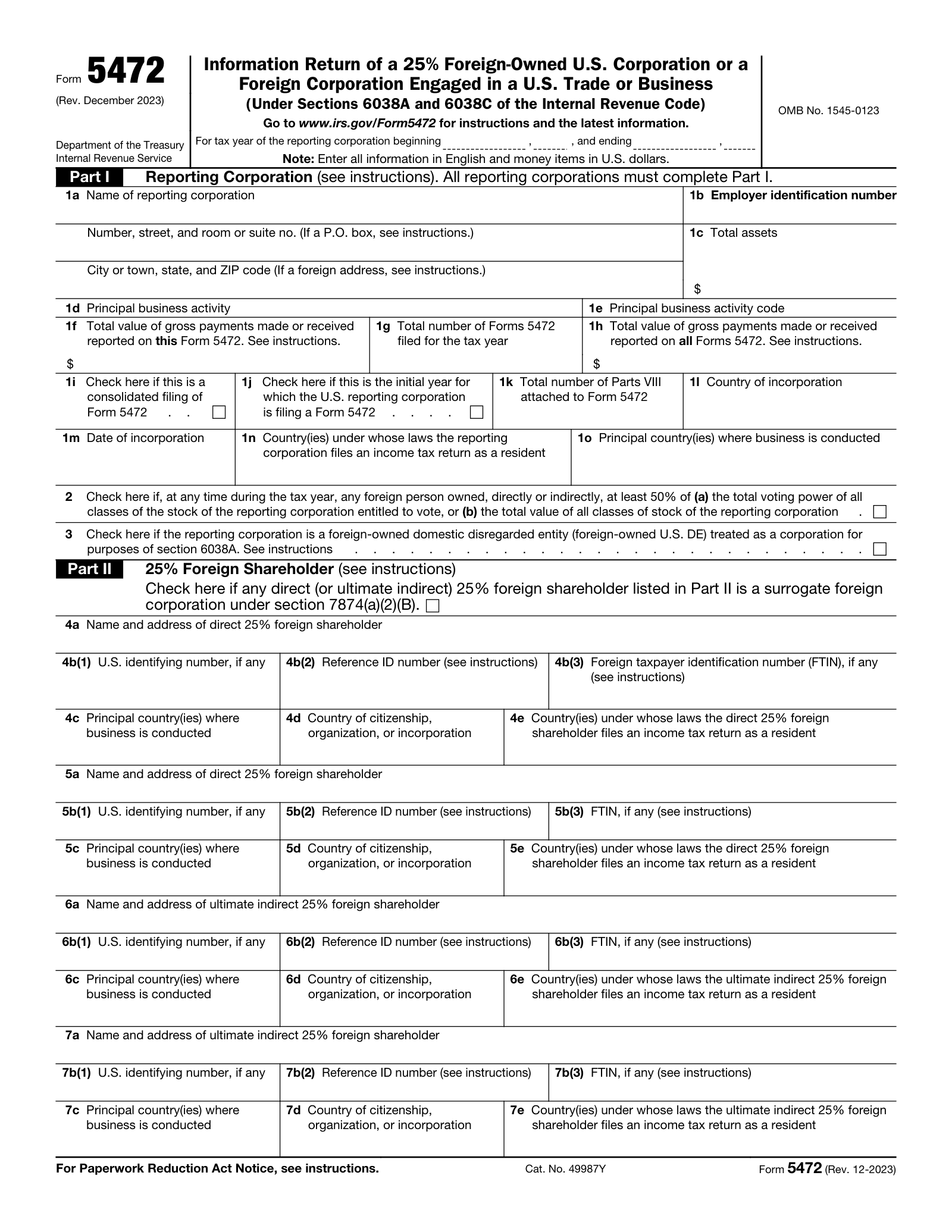
Official form (IRS.gov): Form 5472 official PDF
- Applying to the first provider you find without checking country eligibility or freeze history. Ten minutes of reading saves a rejected application.
- Using a registered-agent or virtual address as the owner's proof of address. It fails verification, and now you have a rejection on record.
- Mixing personal and business transactions. It breaks the liability separation you formed the LLC for, and it looks like commingling to compliance.
- Using the account as a pass-through for friends, family or clients. This is the fastest route to a freeze.
- Ignoring IRS filing obligations. Form 5472 and W-8BEN-E are not optional paperwork; they are the compliance record that supports your banking story. Confirm your obligations with a CPA.
- No backup account. One freeze with no fallback halts the entire business.
- Assuming a traditional bank will accept you remotely. Most will not.
Frequently Asked Questions
Can I open a US business bank account without visiting the US? Yes — fintechs like Mercury, Relay, Wise Business and Payoneer onboard foreign-owned LLCs remotely. Traditional banks usually require an in-person branch visit. Approval is always the provider's decision.
Do I need an SSN or ITIN to open a US business bank account as a non-resident? Not always. Many fintechs accept a passport and a foreign address. Traditional banks and some providers do require an SSN or ITIN. Policies vary by provider, so check before applying.
Which US state is best for a non-resident LLC that needs a bank account? Wyoming, Delaware and New Mexico are common choices. Banks care more about the owner's country of residence and the quality of your documents than about the state of formation.
Why do non-resident US business bank accounts get frozen? Compliance triggers: sudden volume spikes, mismatched addresses, third-party deposits, crypto or gambling activity, or incomplete KYC. Non-resident status alone is not the trigger.
What documents do I need to open a US business bank account as a non-resident? Passport, proof of address, LLC formation documents, the EIN letter (CP 575 or 147c), an operating agreement, and sometimes W-8BEN or W-8BEN-E.
Are these "best bank" lists affiliate-driven? Many are. This comparison is not ranked by commission, and the trade-offs — freeze risk, FX markup, eligibility limits — are stated rather than hidden.
What to do next
Pick two providers that accept your country and your business category. Gather your passport, proof of address, Articles of Organization, EIN letter and operating agreement. Apply to the more stable one first, keep the second as a backup, and keep every address on every document identical.
If you want help with US LLC formation, EIN and business setup, NexFyla can assist.
*Last updated: February 2026.*
Sources
- [1] LLC University — Non-US residents open LLC bank account: https://www.llcuniversity.com/foreigners/open-us-bank-account-llc-non-resident/
- [2] Bank of America — Open a U.S. Bank Account for Non-Residents and Non-Citizens: https://info.bankofamerica.com/en/international/us-bank-account-non-residents
- [3] Reddit r/fintech — Opening a US business bank account as a non-resident: https://www.reddit.com/r/fintech/comments/1ssy4jb/opening_a_us_business_bank_account_as_a/
- [4] U.S. Bank — Open a Business Checking Account: https://www.usbank.com/business-banking/banking-products/business-bank-accounts/business-checking-account.html
- [5] Wise — The 6 best US banks for foreigners & non-residents: https://wise.com/us/blog/best-us-banks-for-foreigners
- [6] Monito — The 7 Best US Banks for Foreigners and Non-Residents: https://www.monito.com/en/wiki/best-us-banks-for-foreigners-in-usa
- [7] Bank of America — Open a U.S. Bank Account for Non-Residents and Non-Citizens: https://info.bankofamerica.com/en/international/us-bank-account-non-residents
- [8] LLC University — Non-US residents open LLC bank account: https://www.llcuniversity.com/foreigners/open-us-bank-account-llc-non-resident/
- [9] U.S. Bank — Open a Business Checking Account: https://www.usbank.com/business-banking/banking-products/business-bank-accounts/business-checking-account.html
- [10] GoCardless — A Non-Resident's Guide to Opening a US Business Bank Account: https://gocardless.com/guides/posts/business-bank-account-in-the-usa
- [11] Reddit r/fintech — Opening a US business bank account as a non-resident: https://www.reddit.com/r/fintech/comments/1ssy4jb/opening_a_us_business_bank_account_as_a/
- [12] Veem — U.S. Business Bank Account for Non-Residents: https://www.veem.com/library/us-business-bank-account-non-resident/
- [13] LLC University — Non-US residents open LLC bank account: https://www.llcuniversity.com/foreigners/open-us-bank-account-llc-non-resident/
- [14] Bank of America — Open a U.S. Bank Account for Non-Residents and Non-Citizens: https://info.bankofamerica.com/en/international/us-bank-account-non-residents
- [15] U.S. Bank — Open a Business Checking Account: https://www.usbank.com/business-banking/banking-products/business-bank-accounts/business-checking-account.html