Yes. A non-US resident can hold a US Stripe account, but not by signing up from home and hoping. Stripe requires a legal entity registered in the US, a tax ID, a physical US location that accepts mail, a phone number, a government-issued ID, a working website, and a physical US bank account .
Can a non-US resident actually get a Stripe account?
Yes. A non-US resident can hold a US Stripe account, but not by signing up from home and hoping. Stripe requires a legal entity registered in the US, a tax ID, a physical US location that accepts mail, a phone number, a government-issued ID, a working website, and a physical US bank account [S2][S14].
Quick Answer: A non-US resident can get a US Stripe account by forming a US LLC, getting an EIN from the IRS, opening a US business bank account in the LLC's name, and applying with the US selected as the country. Stripe verifies the legal entity name, entity type, EIN, SSN or ITIN, and business address [S3][S15]. Approval is Stripe's decision, not a formality.
There are two paths, and most people pick the wrong one first.
Path A is Stripe in your own country. Stripe processes payments in a long list of countries, and if yours is on it, you register there with your local entity and local bank account [S1][S13]. No US LLC, no EIN, no Form 5472. It is simpler and cheaper, which is exactly why people skip it the moment they hear "US LLC" somewhere.
Path B is the US route. You form a US LLC, get an EIN, open a US bank account, and apply for Stripe with the country set to the United States [S5].
A non-resident cannot just sign up as a sole proprietor and skip the LLC. One line in Stripe's US requirements settles it: unregistered businesses must have a business owner or representative physically located in the US [S8][S15]. If you live in Bengaluru or Lagos, you fail that test. Registered businesses only need to be registered in the US, even if you operate elsewhere [S15]. That single sentence is the entire reason the LLC route exists.
Heads-up: Stripe's country list and account requirements change. Check stripe.com/global and Stripe's support pages before you spend money on formation [S1].
What does Stripe actually verify for a US account?
Stripe verifies five things: your legal entity name, your legal entity type (LLC, sole proprietor, and so on), your EIN, your SSN or ITIN, and your business address. Stripe may also ask for official documents to confirm them [S3][S15].
That list explains most of the freeze stories you have read about.
Three of them cause most of the trouble. The EIN is your company's tax ID, issued by the IRS. The SSN or ITIN is the owner's personal tax ID: an SSN for US citizens and residents, an ITIN for people who need a US tax ID but cannot get an SSN. Most non-residents have neither when they first apply, and for a business representative who is not a US individual and has no SSN or ITIN, Stripe's published guidance is to supply a local non-US tax ID together with documentation confirming you are not a US taxpayer [S16]. The business address is the physical location where the majority of your business activity happens; PO Boxes are rejected outright [S15].
The name-match chain
Four documents carry your company's name: the LLC formation document (your Articles of Organization), the EIN letter from the IRS, the US bank account, and the Stripe account. All four must read the same way.
Say your LLC is registered as "Northwind Digital LLC" but the bank account was opened as "Northwind Digital" and Stripe got "Northwind Digital LLC." That is a mismatch, and mismatches are what trigger manual review. It is not fraud, just friction.
Same logic for the address. The address you type into Stripe should match the address on your formation documents and your bank account. If Stripe's file shows your registered agent's address while your bank shows something else, expect questions.
Website, phone number, and business presence
Stripe also wants a working website and a reachable phone number [S2][S14]. A parked domain and a Google Voice number are not a business presence. If your site does not explain what you sell and to whom, you are asking an underwriter to guess.
What you need before you apply: LLC, EIN, US bank account, and a real address
You need four things in place before you touch Stripe's signup form: a US LLC, an EIN, a US business bank account in the LLC's name, and a physical US business address [S5][S15].
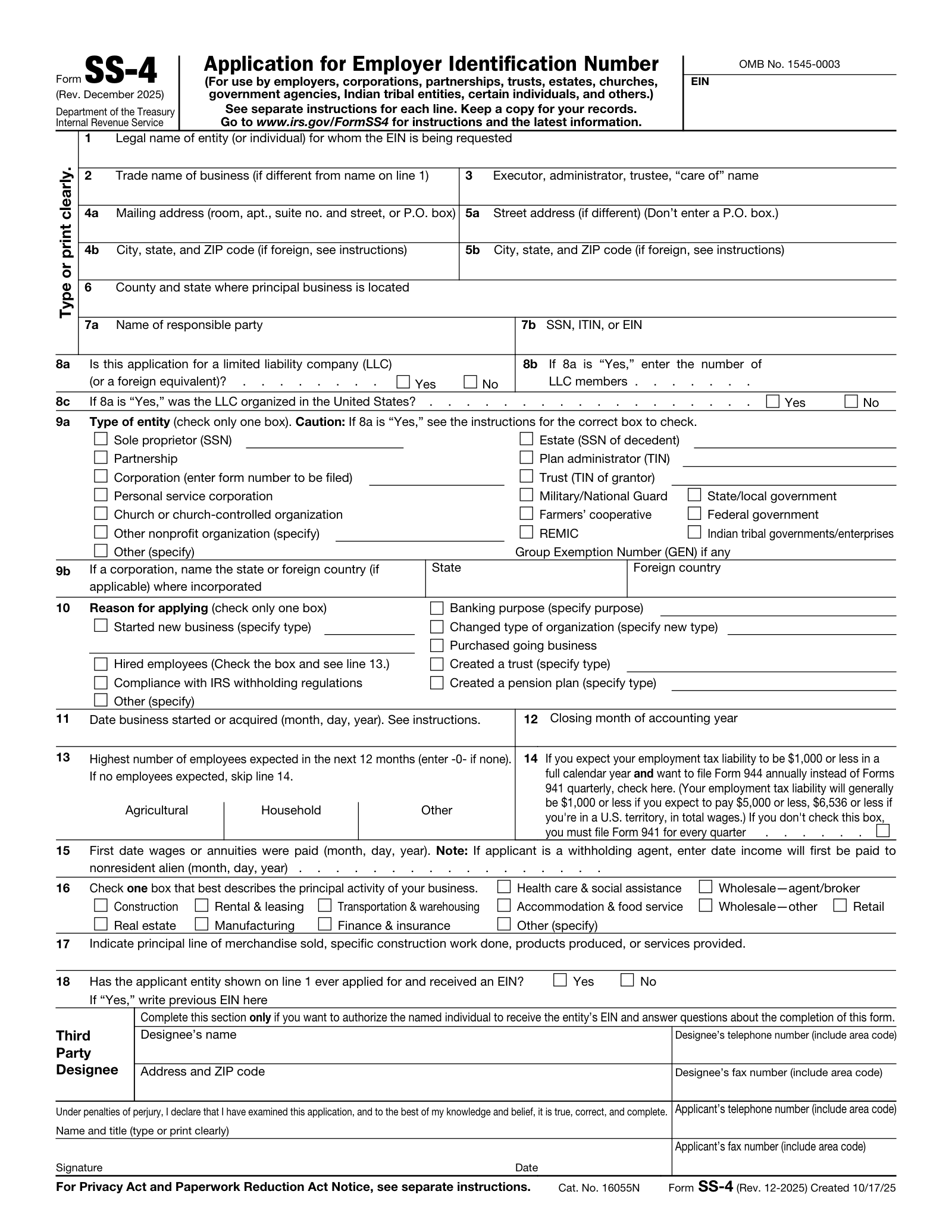
Official form (IRS.gov): Form SS-4 official PDF
Start with the LLC. Delaware and Wyoming are the two states non-residents pick most, though neither is required by Stripe: the rule is simply that the entity is registered in the US [S15]. Choose on cost and franchise tax, not on what a YouTube thumbnail told you.
| Factor | Delaware LLC | Wyoming LLC |
|---|---|---|
| State filing fee | Check the current official fee | Check the current official fee |
| Annual franchise or license tax | Varies by structure | Varies |
| Registered agent required | Yes | Yes |
| Privacy of member names | Varies | Varies |
| Best fit | Investors, C-corp conversion later | Solo founders, cost control |
Then the EIN, via IRS Form SS-4. Applicants without a US SSN, EIN, or ITIN cannot use the online application and file by fax or mail instead (international applicants may also apply by telephone). The number itself is free from the IRS. Formation services charge for handling the paperwork, and that is a service fee, not a government fee. Under the IRS Fax-TIN program, a faxed Form SS-4 generally comes back within 4 business days; a mailed application takes about 4 weeks, and the IRS advises filing 4 to 5 weeks before you need the number [S17].
Next comes the US bank account. Mercury, Relay, and Brex are the usual picks for business banking; Wise and Payoneer handle multi-currency receiving. Stripe requires a physical US bank account whose name matches the LLC [S2][S14], so a personal Wise account in your own name will not do. Stripe does not publish which fintech providers it accepts, though Mercury, Relay, and Brex come up constantly among non-resident LLCs, and all three support Stripe payouts. Mercury even offers a native Stripe integration [S20].
Finally, the address: a real physical location where business activity happens. A registered agent's address is a legal service address, not an operating location, and using it as your business address is one of the most common reasons accounts get flagged [S6][S11].
Costs break into three buckets, and mixing them is how people get surprised:
- Government fees: state filing fee, annual state report or franchise tax.
- Provider fees: formation service, registered agent setup, EIN handling.
- Recurring fees: registered agent renewal, bank account fees, address service.
Step-by-step: how to open a US Stripe account as a non-resident
Finish the LLC, EIN, and bank account first, then create the Stripe account with the United States selected as your country, enter the EIN and business details, add the owner and passport, and connect the US bank account [S2][S5][S15].
Work through it in this order, and try not to skip ahead. First, check that you can apply at all: the US has to be in Stripe's supported list, and your business model has to be off the restricted list [S1]. Then assemble the documents, which means LLC formation documents, the EIN letter (CP 575, or a 147c letter if you need a replacement), bank account details, passport, proof of business address, and a live website.
Next, create the account with the United States as your country, and enter the LLC's legal name exactly as it appears on the EIN letter. Not the trading name, not the brand. Fill in the business details next: entity type LLC, the EIN, the physical business address that matches your formation documents, your industry, and your website. Then the owner details, using the name as printed on your passport, your date of birth, address, and the tax ID field. A non-US owner with no SSN or ITIN should enter their local non-US tax ID and provide supporting documentation rather than leaving the field blank [S16].
Finally, connect the bank account (the account name must match the LLC name) and finish identity verification with your passport and any selfie or liveness check. Once you are approved, run a small test charge before pushing real volume through it.
Tip: keep a folder with all of these documents in one place. When Stripe asks for something during review, speed matters more than polish.
Why do non-resident Stripe accounts get frozen or rejected?
Most freezes and rejections trace to four causes: name or address mismatches, virtual-only addresses, a business model Stripe does not support, and missing or incorrect tax IDs [S3][S15].
Mismatches are the boring one and the most common. The LLC name on the EIN letter differs from the bank account name. The business address is a registered agent or virtual office. The owner's name does not match the passport. None of these look like fraud to you. All of them look like a discrepancy to a risk system.
Business model matters more than people expect. Dropshipping, digital products with heavy chargebacks, adult content, gambling, crypto, and similar categories sit in higher-risk territory and invite review. Stripe does not publish the full logic behind its risk decisions.
Tax ID confusion is a close third. Entering the EIN where a personal tax ID belongs, or the reverse. Same story with a personal bank account instead of a business one.
Freezes after approval usually trace back to behavior: a sudden volume spike, a rising dispute rate, or an invoice request that goes unanswered. Rolling reserves, where Stripe holds back a percentage of your volume for a period, are a standard risk tool. Stripe does not publish a fixed reserve percentage or a standard band: it sets reserves per account when its risk model flags elevated exposure, and Stripe's own documentation caps a hold's scheduled release at 180 days from creation [S18].
Staying out of trouble comes down to consistency. Keep the name and address chain identical across all four documents, and use a real business address rather than a mail-forwarding one. Ramp volume gradually instead of processing a year's revenue in week one. When Stripe asks for something, answer within a day with the actual documents, and keep invoices, supplier contracts, and customer records on hand before anyone asks for them.
Stripe Atlas vs forming your own LLC: which is better for non-residents?
Stripe Atlas is a paid formation service that handles Delaware C-corp or LLC incorporation, registered agent setup, and the EIN application end to end for non-residents, according to Stripe's own resource page [S9]. Doing it yourself with a Wyoming or Delaware LLC costs less and takes more of your time.
Atlas makes sense when you want speed, when you are building toward a Delaware C-corp for fundraising, and when paying a premium for someone else to handle the paperwork is worth it to you.
DIY makes sense when you are a solo founder running an LLC, you want to control the cost, and you are comfortable filing Form SS-4 and walking a bank through onboarding.
| Stripe Atlas | DIY LLC (Wyoming or Delaware) | |
|---|---|---|
| Entity options | Delaware C-corp or LLC [S9] | Any state, any entity |
| EIN handling | Included per Stripe's page [S9] | You file Form SS-4 |
| Registered agent | Included per Stripe's page [S9] | You choose and pay one |
| Cost | Check Stripe Atlas current pricing | State fee plus provider fees |
| Bank account | Guidance only | You open it yourself |
| Stripe approval | Not guaranteed | Not guaranteed |
That last row is the one people miss. Atlas is a Stripe product, but it does not approve your Stripe account. Underwriting still runs on the same rules [S3][S15].
If Stripe declines you: realistic alternatives for non-US residents
The realistic alternatives differ by job. Paddle and Lemon Squeezy are merchant-of-record platforms; Payoneer and Wise specialize in receiving and payouts; and regional gateways such as Razorpay in India make sense when your customers sit mostly in one country.
Merchant-of-record platforms act as the seller of record. They handle sales tax and much of the compliance burden, and in exchange they take a larger cut and own more of the customer relationship. For a solo founder selling digital products into multiple countries, that trade is often worth it.
Payoneer and Wise are for receiving and moving money. Neither replaces Stripe for card processing on your own site, and neither is a substitute for a US business bank account in your LLC's name.
Regional gateways work when your customers are local. If you sell mostly into India, Razorpay is a more natural fit than a US Stripe account.
If you want to reapply to Stripe, fix the actual cause first: the mismatch, the address, or the business model. Repeated failed applications do not help your case.
Common mistakes non-residents make with Stripe
The failure modes below show up roughly in this order of frequency.
Using a personal bank account is the most common mistake. A Wise or Payoneer account in your own name is not a US business account in the LLC's name; Stripe requires a physical US bank account, and the names have to match [S2][S14].
Close behind is listing a registered agent or virtual office as the business address. Stripe wants the physical location where the majority of business activity happens, and PO Boxes are not accepted [S15]. A registered agent address is a legal service address, and non-residents report it getting flagged [S6][S11].
Then there is plain tax ID confusion. The EIN belongs to the business, the SSN or ITIN belongs to the owner, and putting the EIN in the owner field is a mismatch waiting to happen [S3].
A sneakier one: forming the LLC and never getting the EIN. Some formation services advertise "EIN included" without actually filing Form SS-4. Make sure the IRS letter is in your hands.
The one that costs real money is ignoring the annual tax filing. A foreign-owned single-member LLC generally files Form 5472 attached to a pro-forma Form 1120, due April 15 for a calendar-year entity (October 15 with Form 7004 for an extension), and the penalty for not filing, or filing a substantially incomplete form, is $25,000 per form, per year [S19]. That has nothing to do with Stripe on day one, and everything to do with your company staying clean later.
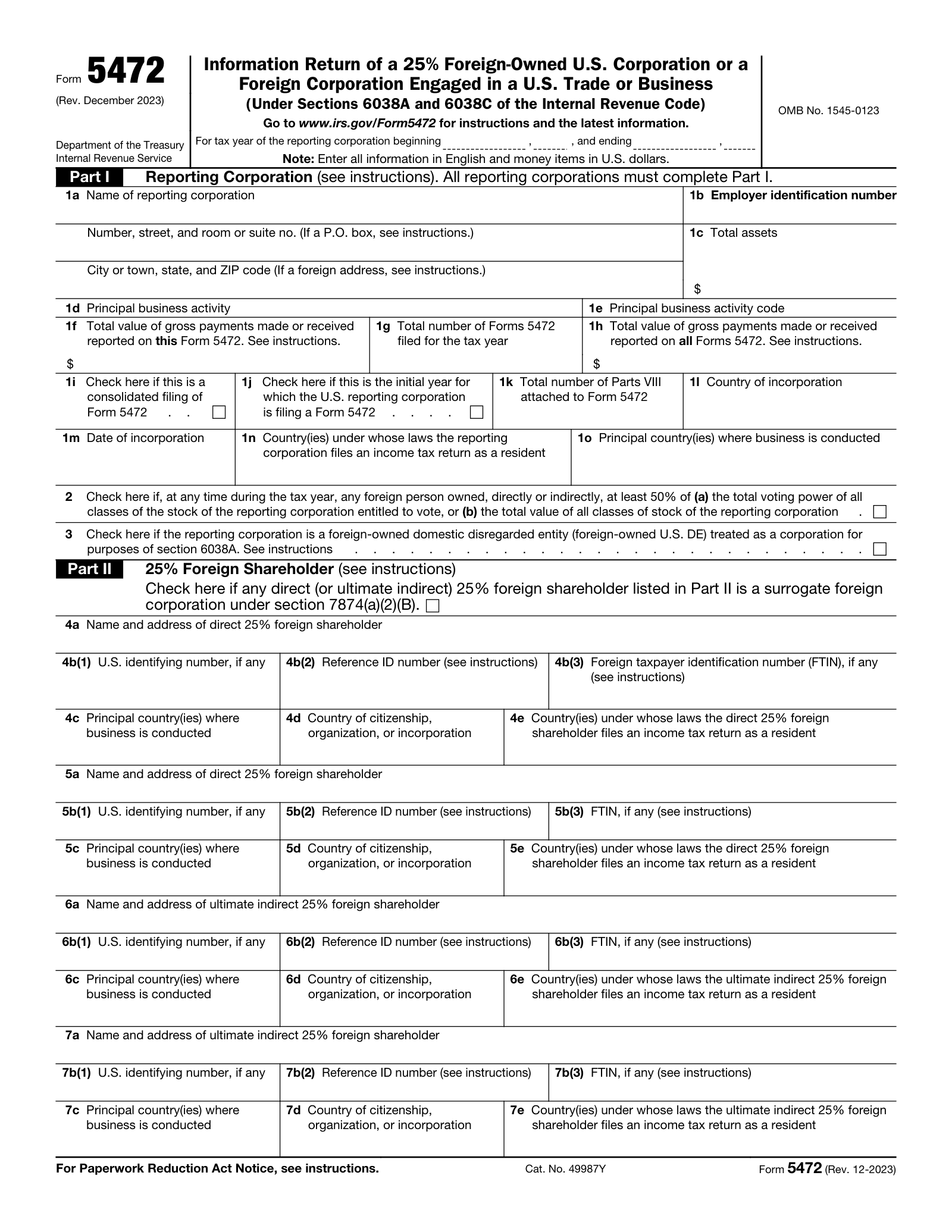
Official form (IRS.gov): Form 5472 official PDF
Spiking volume right after approval is another classic. Going from zero to a large monthly number in the first weeks is one of the most reliable ways to trigger a risk review, so increase it gradually.
And finally, no working website at application time. A parked domain does not describe a business, and Stripe wants a working site as part of the setup [S2][S14].
Frequently Asked Questions
Can I get Stripe without an SSN or ITIN? Yes, through a US LLC with an EIN. Stripe verifies the entity name, entity type, EIN, SSN or ITIN, and business address [S3][S15]. Where a business representative is not a US individual and has no SSN or ITIN, Stripe's guidance is to provide a local non-US tax ID and documentation instead [S16].
Does Stripe accept a registered agent or virtual address? Stripe requires the address of the physical location where the majority of business activity is carried out, and PO Boxes are not accepted [S15]. Registered agent and virtual office addresses can get flagged [S6][S11].
Which US state is best for a non-resident LLC for Stripe? Stripe does not require a specific state; the entity just has to be registered in the US [S15]. Delaware and Wyoming are the common picks. Decide on franchise tax, privacy, and registered agent cost.
Why was my Stripe account frozen after approval? Typical triggers are name or address mismatches, a sharp volume spike, a high dispute rate, or an unanswered request for invoices and supplier contracts. Respond quickly with real documents.
Can I use Wise or Payoneer with Stripe? Stripe requires a physical bank account in the US, and the account name must match the LLC [S2][S14]. Wise and Payoneer are useful for receiving payouts, but a personal account in your own name is not a US business account. Stripe does not publish a list of accepted providers; Mercury, Relay, and Brex business accounts in the LLC's name are the ones non-residents use most with Stripe [S20].
What are the best Stripe alternatives for non-US residents? Paddle and Lemon Squeezy as merchant-of-record platforms, Payoneer and Wise for receiving, and regional gateways like Razorpay if your customers are local. Each carries different fees and different compliance handling.
Setting this up without the guesswork
Getting a US Stripe account as a non-resident is a sequencing problem. LLC, then EIN, then US business bank account, then Stripe, with the same legal name and the same physical address on every document. Skip a step or let a name drift, and you are back in review.
NexFyla helps non-US founders form US companies and set up EIN and US business banking support, which is the part that has to be right before Stripe is even in the picture. If you want help with US LLC formation, EIN and business setup, NexFyla can assist.
Last updated: October 2026.
Sources
- [S1] Stripe global availability - https://stripe.com/global
- [S2] Requirements to open a Stripe account in another country - https://support.stripe.com/questions/requirements-to-open-a-stripe-account-in-another-country
- [S3] Requirements for having a US Stripe account - https://support.stripe.com/questions/requirements-for-having-a-us-stripe-account
- [S5] How to Open a U.S. Stripe Account as a Non-Resident (2026 Guide) - https://startfleet.io/guide/accepting-online-payments-with-stripe
- [S6] Non-US resident here, need advice on forming a US LLC - r/stripe - https://www.reddit.com/r/stripe/comments/1mw4umq/nonus_resident_here_need_advice_on_forming_a_us/
- [S8] Requirements for having a US Stripe account - https://support.stripe.com/questions/requirements-for-having-a-us-stripe-account
- [S9] How to register a US business as a nonresident - Stripe - https://stripe.com/resources/more/how-to-register-a-us-business-as-a-nonresident-a-step-by-step-guide
- [S11] Non-US resident here, need advice on forming a US LLC - r/stripe - https://www.reddit.com/r/stripe/comments/1mw4umq/nonus_resident_here_need_advice_on_forming_a_us/
- [S13] Stripe global availability - https://stripe.com/global
- [S14] Requirements to open a Stripe account in another country - https://support.stripe.com/questions/requirements-to-open-a-stripe-account-in-another-country
- [S15] Requirements for having a US Stripe account - https://support.stripe.com/questions/requirements-for-having-a-us-stripe-account
- [S16] Business Rep/Owner Tax ID requirements for US Companies - Stripe - https://support.stripe.com/questions/business-rep-owner-tax-id-requirements-for-us-companies
- [S17] Instructions for Form SS-4 (Rev. December 2025) - IRS - https://www.irs.gov/instructions/iss4
- [S18] Account balances (reserves) - Stripe Docs - https://docs.stripe.com/connect/account-balances
- [S19] Instructions for Form 5472 (Rev. December 2024) - IRS - https://www.irs.gov/pub/irs-pdf/i5472.pdf
- [S20] How to Open a US Business Bank Account as a Non-Resident (2026) - StartFleet - https://startfleet.io/guide/us-business-bank-account-for-non-us-resident-guide