Table of Contents
▼
What is an ITIN and who qualifies as a non-resident?
An ITIN is a 9-digit number the IRS issues to people who must file a US federal tax return but can't get a Social Security number (SSN) [1][7]. You can apply as a non-resident regardless of your immigration status - the IRS issues ITINs to nonresident aliens, resident aliens, and their spouses or dependents [8][12].
Quick Answer: An ITIN (Individual Taxpayer Identification Number) is a personal US tax processing number for people who need to file a US tax return but aren't eligible for an SSN. Non-residents apply using Form W-7, and immigration status doesn't matter. An ITIN is for federal tax purposes only - it doesn't give you work authorization, immigration status, or access to US benefits.
ITIN vs SSN vs EIN - don't mix these up
Three numbers, three different jobs:
- ITIN - personal tax ID for an individual who files a US return but has no SSN. Applied for with Form W-7 [3].
- SSN - Social Security number, only for people authorized to work in the US.
- EIN - Employer Identification Number, a business tax ID. You get it with Form SS-4, not Form W-7.
If you own a US LLC as a non-resident, you likely need both: an EIN for the company and, if you have personal US filing obligations, an ITIN for yourself. They are not interchangeable, and the IRS won't accept one where the other belongs. If you're still forming the company, see [INTERNAL LINK: EIN for non-US residents].
What "nonresident alien" means
The IRS sorts individuals into nonresident alien and resident alien using the substantial presence test and, where relevant, a tax treaty. The label decides which forms you file and which treaty benefits apply. For ITIN purposes, both groups can apply [8].
Note: an ITIN is a tax number only. It does not grant work authorization, change your immigration status, or make you eligible for US benefits [9].
Can you apply for an ITIN without filing a US tax return?
Generally no. The default rule is that you attach a completed US tax return to Form W-7 [2][6]. Without a return, you need a specific IRS exception - and wanting an ITIN for a bank account or to get paid by a US client is not one of them.
This is the most misunderstood part of the process. People read "apply for an ITIN" and assume it works like a driver's license - fill a form, get a number. It doesn't. The IRS issues ITINs to people who need to file, not to people who'd find one convenient.
The two legitimate paths
Path 1 - With a tax return. You prepare your US return (for example, a nonresident return reporting US-source income or a treaty claim), attach Form W-7, and send both together [2].
Path 2 - With a qualifying exception document. A narrow set of situations lets you apply without a return. The main categories the IRS recognizes involve:
- Withholding on passive income such as dividends, interest, or royalties
- Third-party reporting, such as a scholarship, grant, or pension
- Other income effectively connected to a US trade or business
- Certain treaty claims and other specific reporting situations
Heads-up: the exception list changes with each revision of the Form W-7 instructions, and the exception must be documented - typically a withholding statement, a letter from the payer, or similar proof.
The bank account trap
Say you formed a Wyoming LLC, you're sitting in Bengaluru, and your US bank asks for a tax ID before it will open the account. You think: ITIN. You file Form W-7 with no return and no exception document. Weeks later, a rejection letter.
Wanting an ITIN to open a US bank account is not an IRS exception. Many banks will open a business account for a non-resident using a foreign passport plus the company's EIN - the ITIN isn't the requirement, it's just one document some banks ask about. For that path, read [INTERNAL LINK: US business bank account].
How do you fill out Form W-7 and which documents must you send?
Complete Form W-7, check the correct "reason for applying" box, and attach proof of identity - usually your passport - plus your tax return or exception document [3][6].
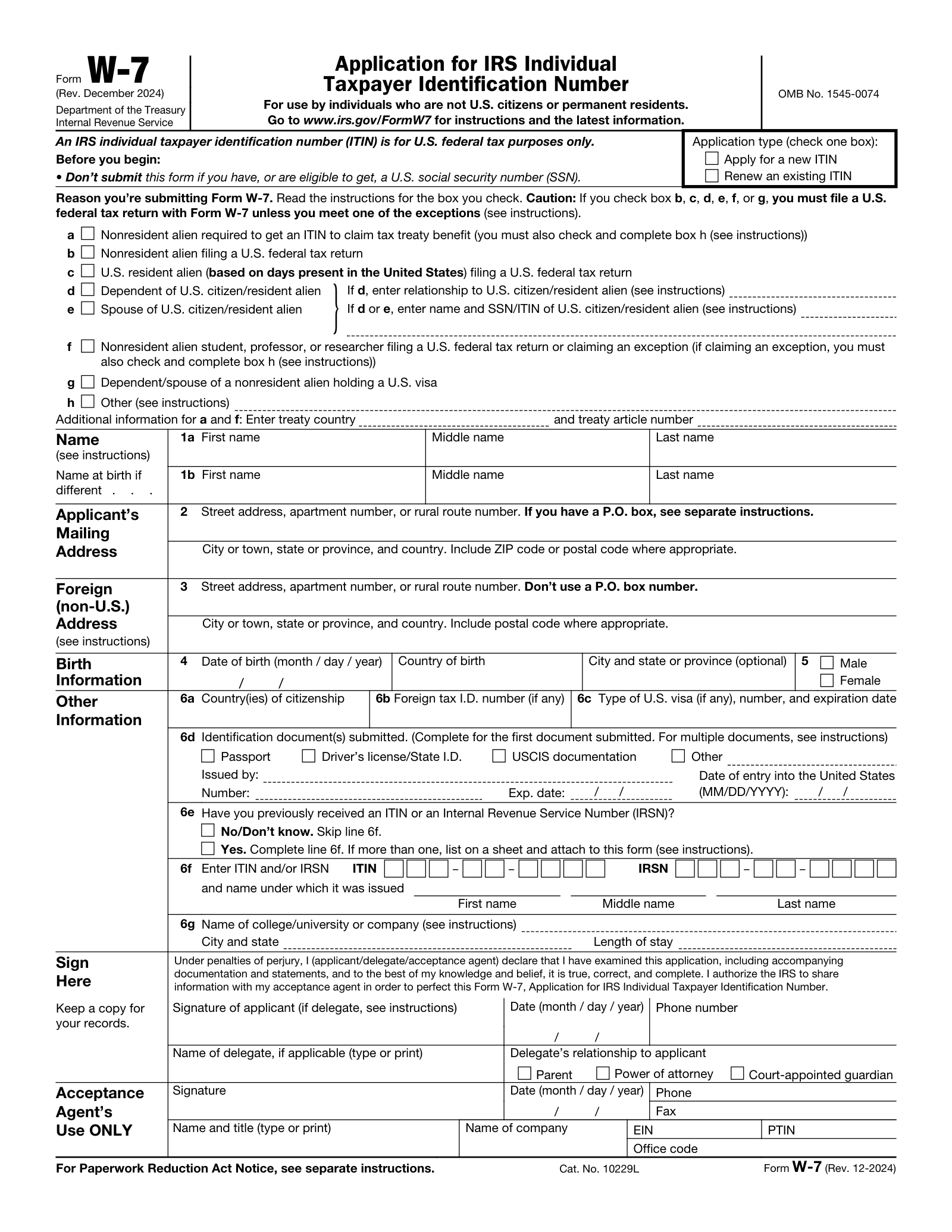
Official form (IRS.gov): Form W-7 official PDF
The fields that trip people up
- Name - spell it exactly as it appears on your passport. A middle name on the passport and a blank on the W-7 is a common mismatch that delays processing.
- Mailing address - a foreign address is fine. The IRS mails the ITIN notice internationally.
- Country of citizenship and date of birth - match your passport.
- Reason for applying - this is the box people get wrong. If you're a non-resident filing a return to report US-source income, you check the box for a nonresident alien filing a US tax return. If you have no US-source income and no return, you should not be checking a filing box at all - you're in the exception category, and you need the document that proves it.
The passport rule
Your passport is the one document the IRS treats as both identity and foreign status proof. You send either:
- The original passport, or
- A certified copy from the agency that issued it.
A notarized copy is not a certified copy. A photocopy stamped by a notary does not satisfy the IRS. This is where a lot of applications fail.
If you mail the original, the IRS returns it - but you're mailing your passport through international post and trusting it comes back. For most non-residents, that's the wrong trade.
What are the ways to submit your ITIN application - and which is safest?
Three routes: mail to the IRS, apply in person at an IRS Taxpayer Assistance Center (TAC) by appointment, or use a Certified Acceptance Agent (CAA) [6]. The CAA route is the one that avoids mailing your original passport.
| Method | Who handles your documents | Government fee | Provider fee | Typical timeline | Risk to original passport |
|---|---|---|---|---|---|
| Mail to IRS | You mail originals or certified copies | No IRS fee to apply | None (postage only) | Check current IRS processing times | High - original passport in international mail |
| IRS Taxpayer Assistance Center | IRS staff verify in person | No IRS fee to apply | None | Check current IRS processing times | None - you keep your passport |
| Certified Acceptance Agent (CAA) | CAA verifies and certifies your documents | No IRS fee to apply | Varies by provider | Check current IRS processing times | None - you keep your passport |
Note: the IRS does not charge a fee to apply for an ITIN. Anything you pay goes to a CAA, an acceptance agent, or a tax preparer for their service.
How the CAA route works
A Certified Acceptance Agent is authorized by the IRS to review your documents and certify copies. You show the CAA your passport, they verify it, and they send the certified documentation with your W-7. Your original never leaves your hands.
If you're in India, that matters. International courier of a passport plus a 7-11 week wait is a bad combination when a CAA can do the verification locally.
TAC appointments are free but limited, and you have to be physically in the US. For most non-residents abroad, it's not a real option.
How long does ITIN processing take and when do you need to renew?
Processing commonly runs around 7-11 weeks, and longer during peak season from January through April when the IRS is buried in returns [2]. Renewals go through the same Form W-7 process [14].
If you need the ITIN for a filing deadline, apply months ahead. A W-7 filed in March for an April deadline will not come back in time.
The three-year rule
An ITIN expires after three consecutive years of not being used on a federal tax return. Use it, and the clock resets. Ignore it, and it lapses - and you're back to filing a W-7.
Separately, the IRS has expired batches of ITINs based on specific middle digits in prior years, requiring those holders to renew even if they'd been using the number. If you received a renewal notice, it applies to you.
Tip: if you have any US filing obligation in a given year, file. It keeps the ITIN alive and costs you nothing extra.
Common Mistakes
Applying for an ITIN purely to open a bank account or receive client payments. Not an exception. The application gets rejected and you've lost weeks. Use the EIN and passport route for banking instead.
Sending a notarized passport copy instead of a certified one. The IRS wants a certified copy from the issuing agency, or the original. A notary stamp doesn't qualify.
Checking the wrong "reason for applying" box. If you have no US-source income and no return, you're in an exception category. Checking a filing box you don't qualify for creates a mismatch the IRS will catch.
Confusing ITIN with EIN. Form W-7 is personal; Form SS-4 is the business. If you're a non-resident LLC owner, you probably need the EIN first. See [INTERNAL LINK: US LLC formation].
Using W-8BEN and W-9 interchangeably. W-9 is for US persons. Non-residents give payers Form W-8BEN (individuals) or Form W-8BEN-E (entities) to claim treaty benefits and document foreign status. Sending a W-9 as a non-resident is a misrepresentation.
Letting the ITIN lapse. Three years of non-use and it's gone. Then it's a fresh W-7.
Ignoring the rejection letter. If the IRS rejects your W-7, respond within the window stated in the notice. Missing it means starting over.
When should you get professional help with an ITIN application?
Get help if you're unsure which exception applies, if you can't get a certified passport copy, or if you've already been rejected once. A Certified Acceptance Agent handles document certification; a tax preparer can build the underlying return and the W-7 together so the two match [6].
That last part is the real value. The W-7 and the return have to tell the same story - same name, same income, same treaty position. When they don't, you get a rejection letter and no explanation you can act on.
One clarification that trips up LLC owners: an ITIN is personal. Your company doesn't get an ITIN - it gets an EIN via Form SS-4. If your US LLC is a single-member LLC owned by a non-resident, the company may also have US filing obligations like Form 5472 and a pro forma Form 1120, which is a separate conversation from your personal ITIN. See [INTERNAL LINK: payment setup] for how W-8BEN fits into getting paid by US clients.
NexFyla helps non-US founders form US companies and set up EIN and US business banking support. ITIN applications are a personal tax matter and separate from company formation - if you need one, work with a CAA or a tax preparer who handles non-resident returns.
Frequently Asked Questions
Can a non-US citizen get a tax ID number? Yes. Non-US citizens who need to file a US tax return and aren't eligible for an SSN can apply for an ITIN with Form W-7, regardless of immigration status [8].
Can I apply for an ITIN without filing a tax return? Only if you meet a specific IRS exception - typically withholding on passive income or third-party reporting. Otherwise you must attach a US tax return to Form W-7 [2].
Do I need an ITIN to open a US bank account? Not necessarily. Many banks accept a foreign passport plus the company's EIN. Wanting an ITIN for a bank account alone is not an IRS exception.
How long does it take to get an ITIN? Commonly around 7-11 weeks, longer during peak filing season [2]. A CAA doesn't speed up the IRS, but it avoids mailing your original passport.
Does an ITIN expire? Yes. ITINs expire after three consecutive years of not being used on a federal tax return, and the IRS has expired certain middle-digit ITINs in prior years [14].
What's the difference between an ITIN and an EIN? An ITIN is a personal tax ID for individuals filing US returns. An EIN is a business tax ID obtained with Form SS-4. Non-resident business owners often need both.
*Last updated: February 2026.*
Sources
[1] IRS - Individual taxpayer identification number (ITIN): https://www.irs.gov/tin/itin/individual-taxpayer-identification-number-itin [2] Taxes for Expats - How to get an ITIN for non-residents: complete 2026 guide: https://www.taxesforexpats.com/articles/non-us-citizens/itin-for-non-resident.html [3] IRS - About Form W-7: https://www.irs.gov/forms-pubs/about-form-w-7 [6] USAGov - Get an Individual Taxpayer Identification Number (ITIN): https://www.usa.gov/itin [7] IRS - Taxpayer identification numbers (TIN): https://www.irs.gov/tin/taxpayer-identification-numbers-tin [8] IRS - Individual taxpayer identification number (ITIN): https://www.irs.gov/tin/itin/individual-taxpayer-identification-number-itin [9] American Immigration Council - The Facts About the ITIN: https://www.americanimmigrationcouncil.org/fact-sheet/facts-about-individual-tax-identification-number-itin/ [12] UW-Madison Business Services - Nonresident Aliens (NRA): https://businessservices.wisc.edu/accounting/tax-compliance-and-reporting/nonresident-aliens/ [14] IRS - About Form W-7: https://www.irs.gov/forms-pubs/about-form-w-7